Pressestatement zum Preisanstieg der Spritpreise im EU-Vergleich
Bonn, 19. März 2026
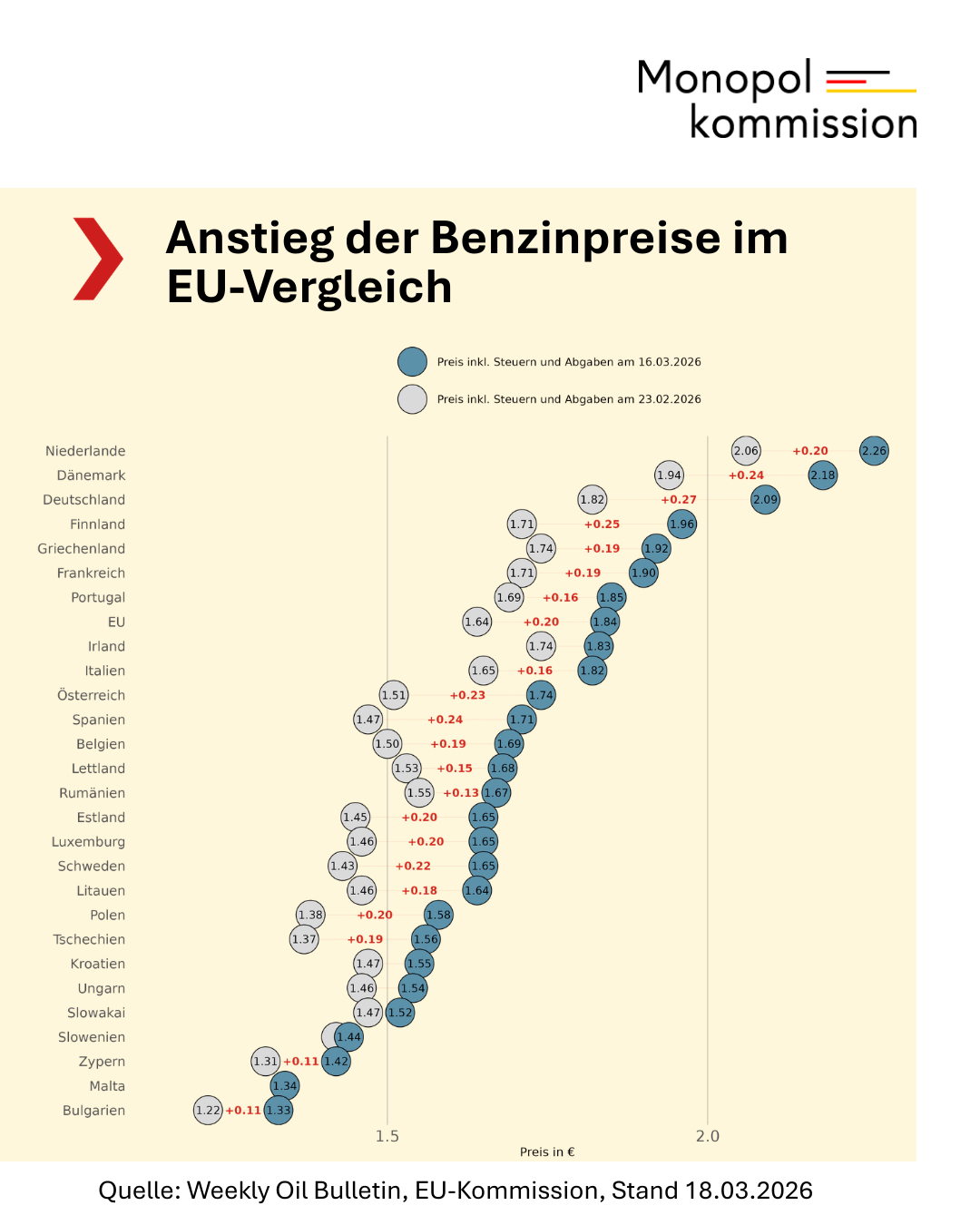
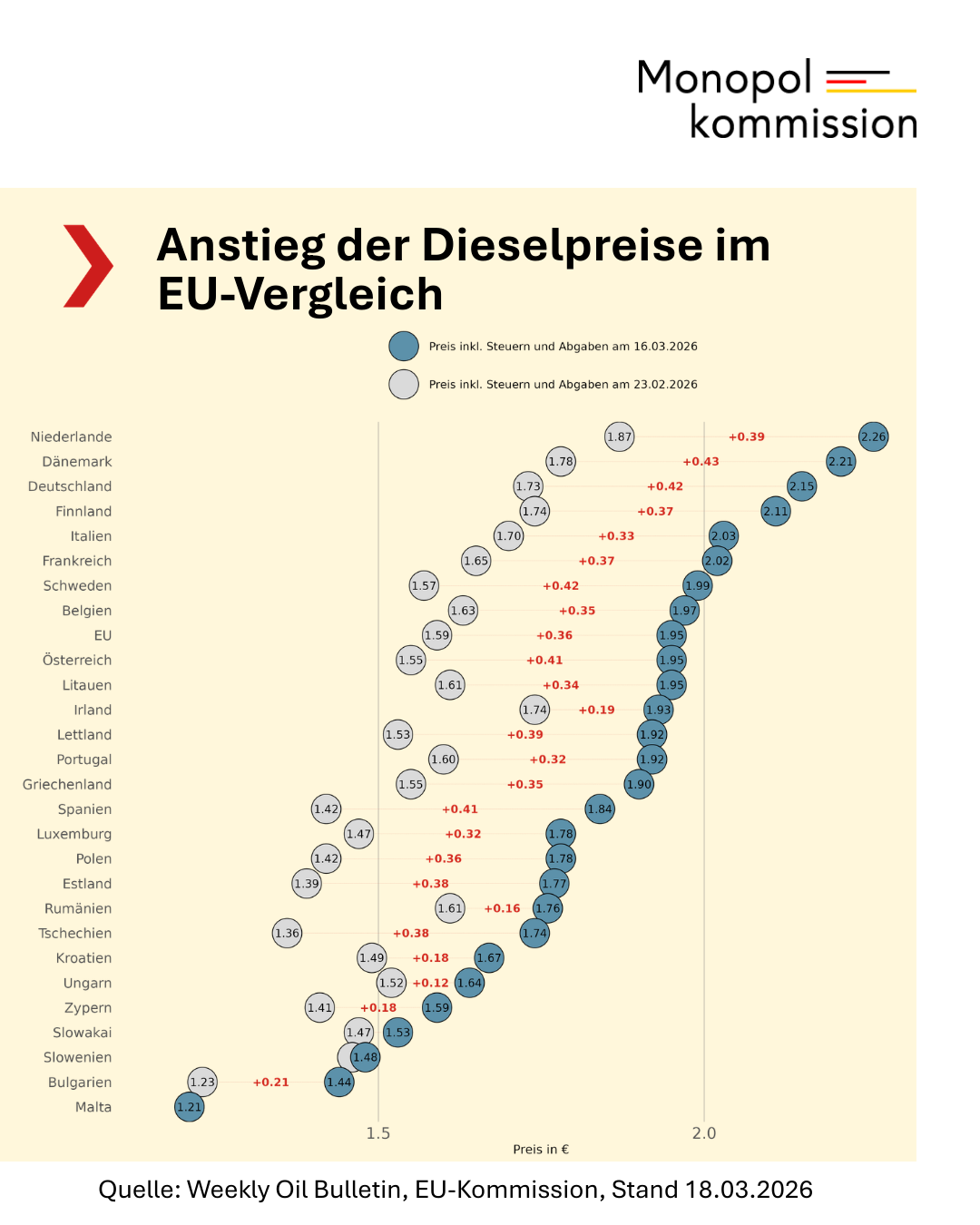
Die aktuellen Daten der EU-Kommission zu den Kraftstoffpreisen der 27 Mitgliedstaaten vom 16. März zeigen, dass Deutschland beim Preisanstieg der Spritpreise weiterhin auf hohem Niveau bleibt. Im Vergleich zur Woche vor Kriegsbeginn gibt es hierzulande einen Anstieg von 27 Cent pro Liter bei Benzin und 42 Cent pro Liter bei Diesel. Der EU-Durchschnitt stieg im selben Zeitraum bei Benzin um 20 Cent pro Liter und beim Diesel um 36 Cent pro Liter. Verglichen mit den Daten vom 9. März zeigt sich: Viele andere EU-Staaten holen auf und nähern sich beim Preisanstieg den deutschen Werten an. Dementsprechend fällt auf, dass der Ölpreisanstieg hierzulande besonders schnell an die Verbraucherinnen und Verbraucher weitergegeben wurden. In Kombination mit dem insgesamt hohen Preisanstieg kann dies auf eine geringere Wettbewerbsintensität im Kraftstoffmarkt hindeuten. In Märkten mit geringem Wettbewerbsdruck oder oligopolistischen Strukturen lassen sich Preiserhöhungen in der Regel leichter und schneller durchsetzen, während sie in Märkten mit mehr Wettbewerb häufig langsamer oder schwächer bei den Verbraucherinnen und Verbrauchern ankommen.
Statement on the Revision of the UTP-Directive
Bonn, 24 February 2026
The Monopolies Commission has submitted a statement to the European Commission as part of the consultation process on the revision of the EU rules on unfair trading practices (UTP Directive) in the food supply chain. In light of the significant economic pressures faced by farmers due to structural changes and increasing market concentration in downstream sectors, the Monopolies Commission emphasises the importance of effective abuse control. The UTP Directive represents an important complement to the prohibition of abuse. Owing to its clearly formulated prohibitions, it is easier to apply and can therefore have direct relevance in contractual relationships.
Our key recommendations:
- Keep the system of specific prohibitions and update it as practices evolve
- Refrain from interventions in price formation, including a ban on buying below production costs
- Limit the scope to relationships involving farmers and their cooperatives where pass-through is plausible
- Do not add a broad 'general clause'
- Strengthen enforcement to overcome the 'fear factor'
14th Sector Report Telecommunications (2025): With Competition towards a European Single Market!
Sector Report of the Monopolies Commission pursuant to § 195 (2) and (3) of the Telecommunications Act, December 10, 2025
The German Monopolies Commission warns against new monopolies in telecommunications. ‘We are currently in a critical transition phase from copper to fibre technology, especially in Germany. There is a danger that the former state monopolists will become dominant again,’ warned Tomaso Duso, Chairman of the Monopolies Commission. The independent committee, which advises the federal government, has presented its 14th sector report on telecommunications. ‘If the upcoming Digital Networks Act leads to premature deregulation, competition will be severely harmed,’ said Duso.
With the Digital Networks Act, the European Commission plans to harmonise the regulation of telecommunications companies and thus to strengthen the European single market. The Monopolies Commission recommends that companies with market power should continue to be more tightly regulated, at least until effective competition is guaranteed. Overall, the advisory body generally welcomes the planned Digital Networks Act, which will provide important impetus for the completion of the European single market.
Food Markets under Pressure: Market Concentration Increases – Competition Decreases
Special Report on Competition in the Food Supply Chain I 21 November 2025
According to the Monopolies Commission, market concentration in food retail and parts of the food industry has increased significantly in recent years. ‘The power of food retailers and, in some cases, manufacturers has increased significantly at the expense of consumers, while agriculture is often exposed to global market risks,’ explains Tomaso Duso, Chairman of the Monopolies Commission. One reason for this are numer-ous mergers in the industry and the increasing expansion of retail activities to the manufacturing level. The Monopolies Commission, an independent advisory body to the German fed-eral government, submitted its special report on competition in the food supply chain to the Federal Ministry of Economics and the Federal Ministry of Agriculture today. In the report, the Monopolies Commission conducted an in-depth analysis of market conditions. This was prompted by the farmers' protests in 2024 and the high food prices of recent years.
Our key recommendations:
- Closer Scrutiny of Mergers along the Entire Supply Chain
- Effectively Countering Abuse of Power
- Improving the Framework Conditions for Agriculture